A Dude Has Distractions
A Journey with ADHD

When I tell people I have Attention Deficit Hyperactive Disorder, their first reaction is often denial. “No you don’t!” they say, as if I stated I had a large green bird nesting on my head. I can assure you, it’s true. Not about the bird, but about the ADHD. I have a diagnosis and prescription to prove it.
I don’t have the outward signs of hyperactivity that mark most people with ADHD. I am usually calm and move at my own speed. I don’t flit around like a moth from one pretty bright light to the next. My favorite hobby is reading, which involves sitting still and focusing on one thing for hours at a time and usually leads to my second favorite hobby, napping.
While the DSM once separated ADD (Attention Deficit Disorder) from ADHD, they have since been combined and given three classifications: Primarily Inattentive Type, Primarily Hyperactive-Impulsive Type, and Combined Type.
The Hyperactive-Impulsives and Combined Types are the most visible and familiar types of ADHD. We’ve all seen the boy in kindergarten who can’t sit still, can’t control his actions or words, can’t focus for more than a minute and believes rules are just there to get him in trouble. And we’ve all known adults like this. They are the comic relief characters in every cartoon and sitcom, jumping from one big idea to the next and resolving the A-Plot and B-Plot with their hilarious shenanigans.
I am of the Primarily Inattentive Type, the invisible ADHD, the sitcom character who was written out of the show because he kept forgetting to show up to rehearsal.
I have trouble focusing on anything I find boring, and even my hobbies are boring most days. I forget what I’m doing in the middle of doing it and cannot handle any instructions with more than two steps. I will walk away from conversations if you can’t hold my interest.
I was undiagnosed until I was an adult and in therapy after dropping out of college the first time. The problem was, my grades were just too good. I don’t say that as a flex. I did not have to study or work hard to get A’s and B’s, and could usually figure out test questions from context clues. I ended up somewhere in the top ten for my class and was even voted Most Likely To Succeed by my senior class.
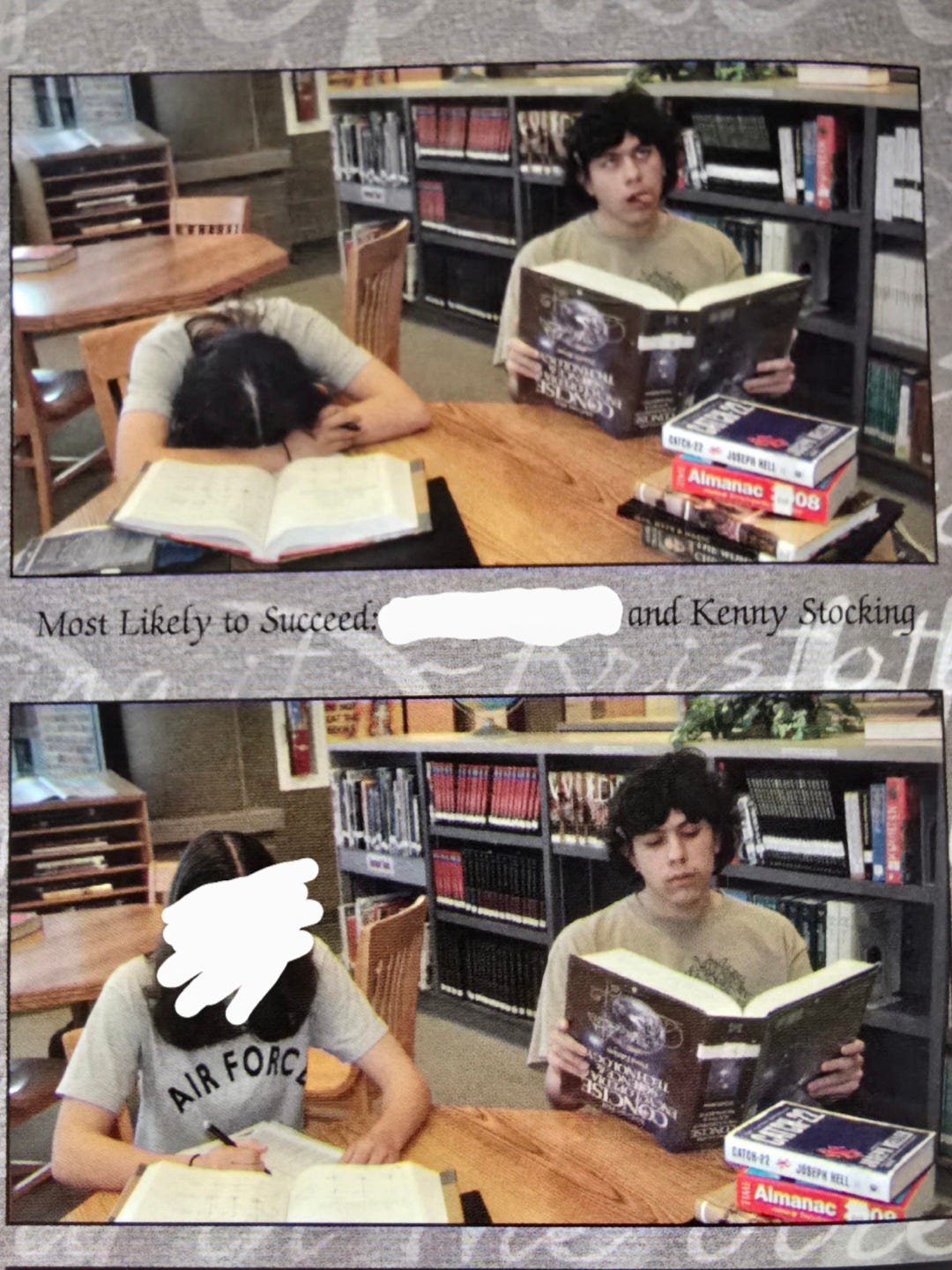
That was the argument my parents made when my 3rd Grade teacher said I should get tested - I was too smart, my grades were good, I didn’t cause trouble in class. So what if I often had a book open under my desk? Or if I was writing stories in a notebook while the teacher was speaking? I could snap out of a daydream and answer a question as soon as it was asked.
But I was struggling. Every test was torture, and though I usually got the questions right I was always last to hand in my work. In-class essay questions were hell. My senior year, I dropped out of my AP English class because I could not focus on the books I was supposed to read over the summer; that did save me from having to read The Fountainhead, though.
When I was looking for colleges supposedly - I don’t quite remember this, but my Mom swears it’s true - I got a letter from Harvard, encouraging me to apply. I threw it away because I knew I would not be able to handle the stress.
And the stress was what did me in. I did get a full ride to New Mexico State University in Las Cruces, and did two years in the English program there. But what worked for me in high school did not work in college; I had to learn how to apply myself from scratch. I had to actually do the assigned readings, actually had to study, and couldn’t bullshit my way through anything above a 101 class. I dropped out after a few weeks into my third year and started going to therapy.
When I mentioned my 3rd Grade teacher wanted me to get tested, my therapist had me tested almost immediately. My scores were so high, they were afraid I was contagious.
I tried to manage it without medication for awhile, but abandoned that idea as quickly as I abandoned most habits and hobbies. I’ve been on some form of medication off and on, insurance permitting, for the past 15 years. And it’s only when I’m on it do I feel like I have it under control.
I did finish my English Degree, with an emphasis in Creative Writing, at Black Hills State University in 2023. I did it without health insurance and without medication, and almost didn’t graduate because of it. I misread the requirements for my emphasis and had to scramble to set up an Independent Study to fulfill them, which the English Department faculty graciously allowed and earned my eternal gratitude. My children shall bear their names.
I finished with a 3.4 GPA, just short of Cum Laude, because of a few low-graded projects I didn’t feel like redoing, and a C grade in one class I couldn’t be bothered to even half ass. I can be bothered to rant about it though:
How am I supposed to prove that Anne Bradstreet was a radical feminist, using evidence from her poetry? IT’S POETRY. THERE IS NO EVIDENCE, DR. KING. IT’S OPEN TO INTERPRETATION AND I AM NOT GOING TO PUT WORDS AND POLITICS INTO THE MOUTH OF A WOMAN WHO HAS BEEN DEAD FOR FIVE CENTURIES, 200 YEARS BEFORE THE RIGHT TO VOTE WAS EVEN A THOUGHT, AND WHO NEVER EVEN MENTIONED POLITICS. I WEAR YOUR C GRADE WITH PRIDE!
Such is life with ADHD. I can’t remember what I ate for breakfast this morning, but I can remember conversations from three years ago if they are associated with novel ideas and strong emotions. The ADHD brain craves novelty, which is why routine and building habits is so difficult. I can disrupt years-long habits just by looking at my phone at the wrong time during. It is easiest to get routine chores done if I change up the routine just a little bit - vacuuming from the bedroom to the front door instead of vice versa, washing dishes with my eyes closed, putting my laundry away in a different drawer. It is the behavior of an insane person but it works.
Currently, I am on 20mg of dextroamphetamine, the generic form of Adderall, and I have noticed it has changed my life in two primary ways: my task paralysis is almost nonexistent, and switching between tasks requires no effort.
Primarily Inattentive ADHD is, for me at least, a problem of executive dysfunction. I simply cannot get started on tasks that are right in front of me. I have no gas, my cord is not plugged in, the lights are on but nobody’s home. I have stared at an overflowing sink, unable to shut off the faucet, at least once. I can have my favorite book or video game in front of me, with no other chores to get done, and be unable to start. I can be late for work and be sitting by the front door, shoes on and ready to go, but be unable to walk out the door. That’s task paralysis.
Task switching is exactly what it sounds like, flowing from one task into another. I can get the dishes done and clean the kitchen, walk to the bathroom to clean it, and then freeze. I can be writing a story, be in the middle of a sentence, turn the page and be unable to continue. I would often have to take long breaks in-between chores to prep myself for something I do every day that takes me five minutes to complete.
Of course, when there’s urgency to the task, a looming deadline, it becomes easier (unless your kitchen is flooding, it would seem). Adrenaline acts as a replacement for the endorphins required to focus, and is novel and exciting enough that I am able to stay on task. I’ve started and finished multiple ten and fifteen page essays the day they were due because of this. It only multiplies the stress I’m under, though, and I often get no satisfaction from completing a task this way.
So why does stimulant medication help? How does giving a hyperactive person a drug that makes neurotypicals bounce off the walls allow the hyperactive person to remain calm and on task? The theory is, and it is supported by a lot of evidence both clinical and anecdotal, that stimulants flood the brain with the endorphins needed to get things done. The Prefrontal Cortex is the part of the brain that deals with Executive Function, focus, and muscle and language control. In ADHD brains, the Prefrontal Cortex is believed to be underdeveloped, or not wired the same way as a neurotypical brain. It uses dopamine and other neurotransmitters to send signals around the brain, sort of like the flight deck of a spaceship.
In an ADHD brain, these signals reach their intended destination or never fire at all, because the flight deck does not have the power to contact all parts of the ship. Stimulants - nicotine, caffeine, dextroamphetamine, and many others - act similar enough to neurotransmitters and/or cause them to be produced in abundance, giving the flight deck the power it needs to command the entire ship. This is also why novelty and excitement can power an ADHD mind - it floods the mind with more endorphins, more neurotransmitters, allowing it to focus. It’s why I can read a book a day or play video games for 8 hours but can’t wash a dish the same day I use it.
Task paralysis is easily overcome when I have enough gas in the tank, and task switching consumes almost no effort.
Being on a new medication or a new dosage is somewhat unnerving. I am not used to going so easily from one task to the next, and my mind likes to resist. It is used to taking a break and will protest. I get a little twinge of anxiety that getting so many things done in a day will wear me out as it has in the past.
In a way, it’s like driving a new car. Yes, they all have the same basic control scheme, but they handle differently and we’re not sure where they begin and end, how quickly they turn, and we have a little freakout when they do something we weren’t expecting. This medication makes me feel like I’m on autopilot sometimes, driving a new car on the highway for the first time and going 0 to 120 in five seconds flat.
It will take some getting used to, relearning what my limits are and when I need to take a break.
societal implications - we work too much, too easily distracted, up to 50% of incarcerated have adhd
Isn’t over prescribing stimulant medications dangerous? Well, prescribing any medication is dangerous. I am lucky that I’ve never had a violent reaction to the stimulants I’ve tried and they’ve worked for me without much hassle. But yes, used incorrectly, or by someone with a sensitivity, can be harmful and even deadly. And aren’t they addictive? Well, they can be, but I always respond to this question with a joke:
No, my medication isn’t addictive, I forget to take it all the time! Have you ever met a crack addict who said “Ah shucks, I forgot to smoke crack today?”
But isn’t medication a crutch? Wouldn’t you feel better with a natural remedy?
I don’t know if you know this, but PEOPLE WITH CRUTCHES NEED THEM. NOBODY WHO HAS A CRUTCH THINKS IT MAKES WALKING EASIER! It makes walking possible! I have been on and off medication for most of my adult life, and I cannot make life without it work. I forget important things I have to do, I spend money impulsively, I say things that might need to be said but not there and then. I am unable to be a fully functioning adult without medication, and so I take it. I’m not going to hobble around on a broken leg for some moral victory, so people will think I am suffering honorably.
But to many people are diagnosed with ADHD these days!
That may be true. Some people might be misdiagnosed and given medication they don’t need. But I don’t think the criteria for diagnosis is faulty. I think most people just aren’t built for the world that requires them to be productive 24/7.
An 8-hour workday, 9-5, 5 days a week, is torture for people with ADHD. They have to focus on a task that has no immediate rewards, no tangible rewards at all, for most of their waking hours. They might make the company millions of dollars, but they’ll end up with the same paycheck at the end of the week. At least when you’re making paper airplanes, after two minutes you have a paper airplane. What do you get for finishing a spreadsheet? More spreadsheets to finish.
And for the ADHD brain, there are more distractions these days than at any point in history and they all fit inside a pretty shiny rectangle in your pocket. A person with ADHD one hundred years ago had to work harder to get their dopamine fix, and may have been able to get by with only the chores around the house to keep them entertained. Plus, many likely self-medicated with cigarettes, as nicotine is a stimulant and some people “go natural” using e-cigs and vapes to treat their ADHD.
The point is, the world as it is now requires more intense focus than at any point in history. And there are more easily accessible distractions than at any point in history.
It is like the jump from high school to college. Suddenly, the techniques you’ve relied on for a decade no longer work, because the workload is much more intense, and because you are now solely responsible for staying on task and completing that workload. Perhaps the over-diagnosis of ADHD isn’t a failure of the medical community or a scheme to sell more medications, but a strain on society as we are pushed to the limits of human focus and find that more and more people fall behind.
A curious statistic associated with ADHD is incarcerated people, those charged with crimes or with a criminal history, are more likely to exhibit ADHD-like behaviors but be undiagnosed. It is estimated that nearly 50% of the prison population have an undiagnosed form of ADHD.
Since the impoverished and lower class are more likely to be charged with crimes, it’s no wonder they’ve never had their therapist recommend to their primary care provider that they be tested for ADHD and have it all charged to insurance. Undiagnosed, those with ADHD often self-medicate with nicotine, caffeine, and illegal substances because it “helps them think” and they are likely 100% right. With poor impulse control, you are more likely to act aggressively, more likely to steal, more likely to break the rules without regard for the consequences.
What, if anything, can we take away from this, the ramblings of an insane, insecure, and easily-distracted madman with multiple maxed out credit cards and two dozen unbuilt LEGO sets?
I’m not sure. But I see more and more people struggling these days, more and more people falling behind, and I recognize in them the same young man I was in my first two years of college. If nobody can finish the assignment, then the assignment is too damn hard and of no use to anybody.